
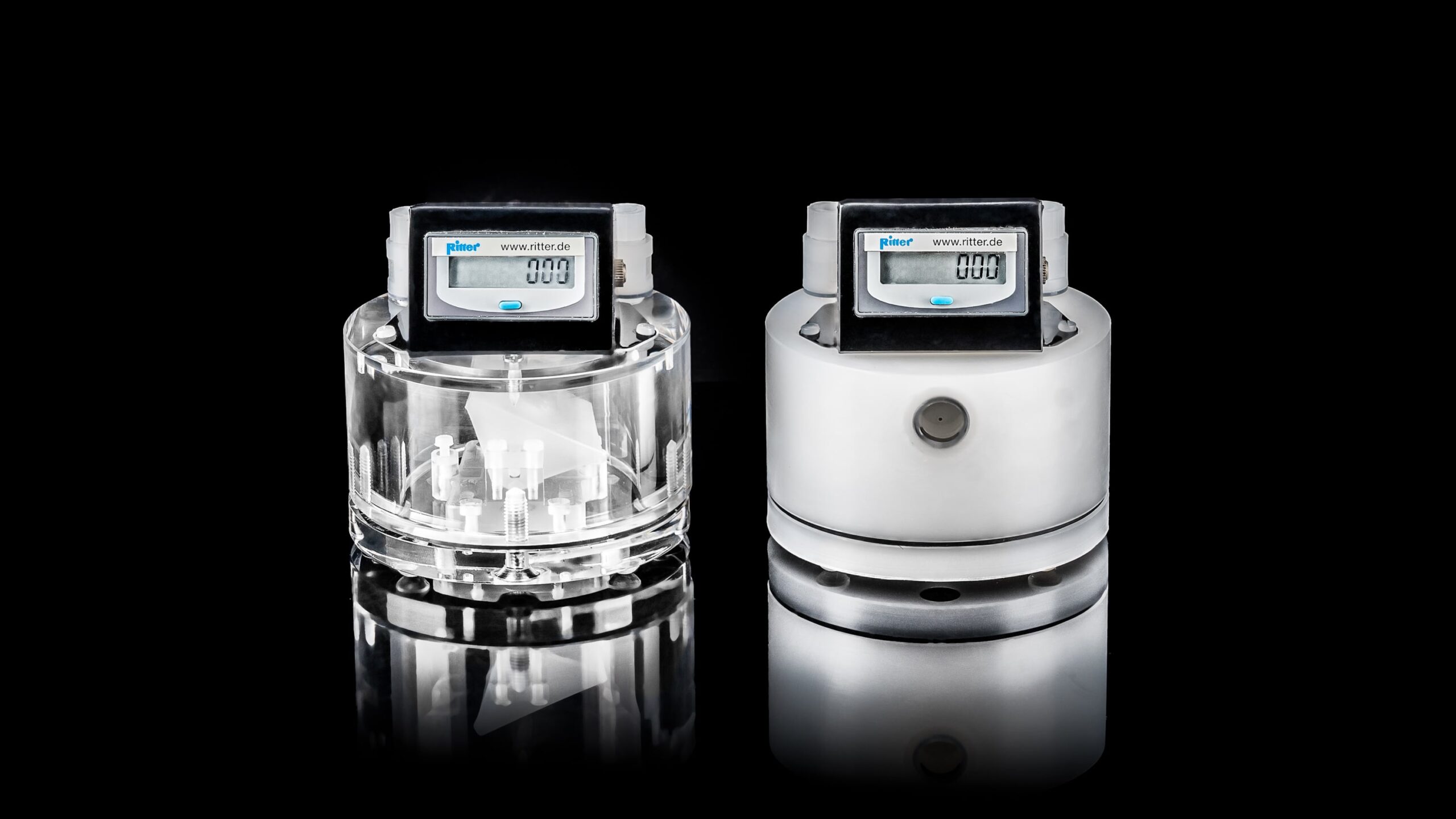
Precise Volumetric Gas Measurement for Ultra-Low Flow Applications
When gas volumes become extremely small, measurement quality becomes critical.
The RITTER MilliGascounter (MGC) was developed for accurate volumetric measurement of ultra-low gas flows from 1 ml/h up to 1 l/h. Designed for laboratory and research environments, the MGC combines precise physical measurement principles with long-term stability and exceptionally reliable reproducibility.
Unlike thermal or mass-flow based systems, the MGC measures actual gas volume directly – independent of gas composition, humidity or changing methane concentrations. This makes the system especially valuable for demanding research applications where gas mixtures vary over time and consistent long-term measurements are essential.
Widely used in biogas research, fermentation analysis, electrochemical studies and leak detection applications, the MGC has become a trusted instrument for laboratories and research facilities worldwide.
Why Researchers Choose the RITTER MGC
True Volumetric Measurement
The MGC directly measures displaced gas volume physically rather than estimating flow behavior through thermal models or gas-specific calibration assumptions.
This allows highly stable measurements even under changing gas compositions and fluctuating environmental conditions.
Exceptional Low-Flow Sensitivity
The system is optimized for extremely small gas volumes and continuous micro-flow measurements where conventional gas meters often reach their practical limits.
Individually Calibrated Instruments
Each MilliGascounter is individually calibrated to ensure reliable and reproducible results across long-term experiments and research processes.
Reliable Long-Term Stability
The robust twin-chamber measuring principle allows continuous operation with minimal drift and very low maintenance requirements.
Flexible Material Options
Depending on gas composition and chemical resistance requirements, the MGC is available in PMMA and PVDF versions for inert, slightly corrosive or aggressive gases.
Key Technical Data
- Measuring range: 1 ml/h to 1 l/h
- Volumetric direct gas measurement
- Accuracy: ±3 %
- Better than ±1 % in combination with RIGAMO software
- Resolution approximately 3 ml
- Digital pulse output
- Individually calibrated devices
- Long-term stable laboratory operation
- Suitable for continuous experiments
Typical Applications
The RITTER MGC is ideally suited for:
- Biogas and methane production studies
- Fermentation and microbiological research
- Hydrogen and leakage testing
- Electrochemical gas generation experiments
- Battery off-gassing analysis
- Catalyst and material research
- Academic laboratory applications
- Continuous low-flow gas monitoring
Measuring Principle
The MilliGascounter uses a highly precise twin-chamber volumetric measuring principle. Gas entering the system alternately fills and tilts the measuring chambers. Each completed chamber movement corresponds to a defined gas volume and generates a digital counting pulse. This direct physical approach enables highly reproducible gas volume measurement independent of gas composition or thermal properties.
Additional technical information, application details and downloadable data sheets are available on the official RITTER product page:
https://www.ritter.de/en/products/milligascounters/
Designed for Scientific and Industrial Research
The RITTER MilliGascounter combines laboratory-grade precision with practical long-term usability. Researchers benefit from stable measurements, excellent reproducibility and a measuring principle trusted in scientific environments for decades.
Whether used in biogas research, electrochemical analysis or advanced laboratory studies, the MGC delivers dependable volumetric gas measurement exactly where ultra-low flow precision matters most.
Need Support Selecting the Right Configuration?
Our team will gladly help you select the appropriate MGC version, material configuration and software integration for your specific application.
Contact RITTER US for technical guidance, application support and quotation requests.

Patrick Anderson combines more than two decades of experience in supply chain, system integration, and operational excellence with the innovations of RITTER, the global market leader in volumetric gas measurement from Germany. With developments in the biogas segment and modern gas analysis, RITTER US delivers scalable solutions for the future of gas handling, and Patrick is an ideal partner in your network.
RITTER US – Serving the USA & Mexico


